Self-Awareness & Self-Responsibility
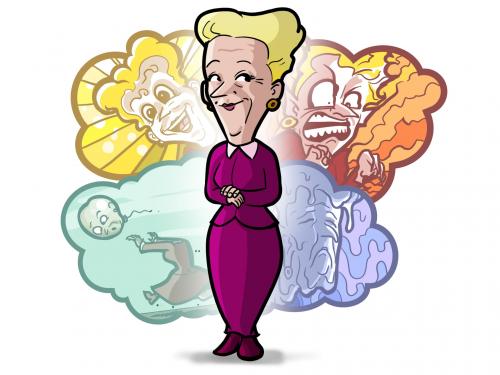
When living with bipolar disorder (BPD), being aware of our condition is crucial.
Of course I do not expect a Bi-Polar Lander going through a psychotic manic episode to be fully aware of what is going on. By the time somebody reaches that stage it is too late - for that period of time anyway. I have grown up with a father that had BPD (when it was still referred to as ‘manic depression’) and I have seen that at first hand over many years. I also have a friend who has been Sectioned three times under The Mental Health Act over the ten years I have known her.
With the help of medication and for my father the use of Electro-Convulsive Therapy (ECT) both regained a level of awareness that was enough to appreciate the medical situation they were in. These manic and indeed depressive episodes are called ‘episodes’ precisely because they are not a permanent but temporary state (even though they can last anything from weeks to months). It is during these in-between times that we all have the opportunity to learn about our illness and face our condition IF WE CHOOSE TO.
It is in between episodes that we can decide whether:
- We will work WITH our medical support team, starting with our psychiatrist, rather than treat them all like the ‘enemy’
- We will take the medication prescribed to give it a chance to help and we will not give up on meds altogether at the first sign of an unpleasant side effect1
- We will read up on our illness from reputable sources and do our best to understand our own experience within it.
But of course NONE of the above is possible unless we first ACCEPT that we have a chronic mental illness, something that everybody finds VERY hard to do. I was first diagnosed in my thirties and I refused to have anything to do with an illness that had blighted the whole of my childhood and adolescence. It was not until I had a severe major breakdown in my early fifties that I was FORCED to face up to my condition. I was so ill that I lost the ability to speak, which scared me beyond belief.
Nowadays everybody talks about ‘mental health’ but, mention ‘mental illness’, and the conversation dies down immediately. It is true that the stigma is much less than it was in my father’s time when a deep sense of shame was associated with any psychiatric condition and therefore a veil of silence enveloped our experience of it BUT mental illness is still a very frightening thing. The way films and media portray those conditions does not help, which is why raising awareness with valid information is extremely important.
When we come to responsibility, another uncomfortable truth must be faced. As I said in Personality & Character, BPD does not change the core of who we are.
Deep down my father was a loving man but he also had a controlling personality. This meant that he was more concerned with exercising power over others than he was with personal introspection. His manic episodes made this worse but they didn’t create it - his personality did.
Another perfect illustration of this is my friend who has always had a narcissistic personality. What does that mean2 exactly?
- She has always enjoyed conflict - she loves anything that involves a dispute.
- She has always been rigid in her thinking. In the many years I have known her I have never heard her say something like ‘oh I think I was wrong’ - she is always right.
- She has always been antagonistic so, the minute she climbs the manic scale, she goes into battle against the world.
- She has always been the victim. It is always somebody else’s fault.
- Her sense of entitlement has always been quite baffling and extraordinary.
- She has always been emotionally deregulated - in other words unpredictable.
Add a manic episode on top of that and, to this day, she has seen her being Sectioned three times as being the victim of her neighbours’ ill will against her, and any effort on my part to show her a compassionate supportive encouragement to address her illness and take responsibility for her behaviour has been thrown back in my face because as far as she is concerned I am the sick one (which I am) and she is perfectly OK and always has been.
I might sound like I have just carried out a character assassination on my friend but, if anything, I have been kind. I could quote many other people who have suffered from her behaviour and I can assure you that they would be a lot less kind…. Besides, my motivation here is only to illustrate the point I make about responsibility with a real life example.
People who are not willing or able to take responsibility for their actions in life generally are unable or unwilling to take responsibility for their illness and their behaviour within it. Self-responsibility starts with the self. Self-awareness is the first crucial step - self- responsibility is the second.
I have always said that being ill may not be my fault but my behaviour about and within my illness is my responsibility.
I will argue that this is valid for any ADULT Bi-Polar Lander on this planet.
- I speak of this from personal experience - I tried eighteen different medications (!) before and including the three meds I am currently on and to which I refer as my ‘little cocktail’. My experience in this regard is in no way unusual.
- The CRAVED acronym is a useful recognised tool to describe a narcissistic personality.