Bi-Polar Girl: 10 Years On
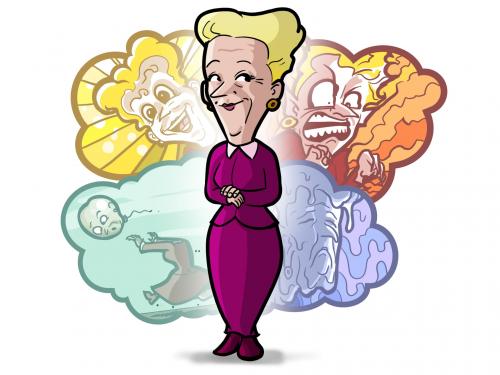
This is my attempt at sharing any ‘wisdom’ I may have acquired over the last ten years or so, since my illness first ‘ruled’ my life, in the hope it might help/validate/encourage someone else (that I refer to as fellow Bi-Polar Landers) in their journey with Bipolar Disorder (BPD).
These are the areas I will share my thoughts on:
- Personality & Character
- Self-Awareness & Self-Responsibility
- Family & Relationships
- Intelligence & Learning
- Fitness & Physical Health
- Work & Charitable Endeavours
- Fun & Hobbies
- Spirituality & Soul
- Life & Death
The rest of my site was created in and around 2013. The demands made upon me became too much and I needed a break from Bi-Polar Girl. I am now back in Bi-Polar Land and I hope you will enjoy the above.
January 2024.
Personality & Character
Personality general definition: the combination of characteristics or qualities that form an individual’s distinctive character.
Personality - psychology: the enduring characteristics and behaviours that comprise a person’s unique adjustment to life, including major traits, interests, drives, values, self-concept, abilities and emotional patterns.
Character vs personality: personality refers to value judgements made about a person’s morals or ethical behaviour, whereas character is the unique way in which each individual thinks, acts, and feels throughout life.
Let’s start at the beginning. Looking at the above definitions and although the following statements appear at first sight to be mutually exclusive, it is immediately apparent to any Bi-Polar Lander that:
- Bi-polar Disorder (BPD) does not change who you are
- But BPD does change who you are.
It is clear to me that my BPD has not changed the combination of characteristics that make me who I am as a person. For example I was always fascinated by language and foreign languages and I am still the strange individual who will watch Polish or Japanese drama with English subtitles just for the sheer fun of it. Similarly I still enjoy learning about anything new on any subject.
As far as my moral character is concerned, my core values haven’t changed either - I still value LOVE in its deepest sense and RESPECT above anything else. My motivation and purpose in this world have remained the same.
From that point of view I am still very much the same person I always was. Some might even say that I am more myself than I have ever been, no doubt due to the ‘maturing’ (like a good wine) process associated with age. As I am writing this I am about to enter my 73rd year.
However, as far as my adjustment to life and my behaviour are concerned, I cannot deny that my BPD has had a massive impact. In fact I could say that having to live with a chronic illness that, by its very nature, grabs you by the brain and moves you up and down like the proverbial yo-yo, requires a huge amount of self-awareness and - dare I say it - COURAGE. Courage I don’t always have. If I am honest my illness still scares me and my first reaction to many situations is fear. That being said, I am of course aware that ANXIETY is part and parcel of the down depressive side of BPD but I feel weaker than I was before my illness took my life over. As a result, I cannot COUNT on my courage being ALWAYS available.
This lack of guaranteed accessibility has a definite impact on my behaviour because I don’t feel I can commit to anything. I never know what I will be like from one day to the next and I hate being unreliable so I don’t do anything that requires reliability or regularity in the ‘outside world’. As a result, my external life has ‘shrunk’ to attending hospital or dental appointments, with the odd hairdresser appointment thrown in.
Also I am afraid to drive - and another thing that keeps me at home is my discomfort in crowds and my fearful confusion when attempting to make and follow travelling arrangements. I rely entirely on my husband for any travelling we do. In this regard I am definitely NOT the person I used to be. I feel nearly ‘disabled’.
BPD is a powerful illness and it is disabling. It may not change us Bi-Polar Landers at our core but it does affect our ability to deal with certain life situations. At best we can adapt ourselves to those changes and we can accept them. At worst we can end up like Don Quixote fighting windmills…
Self-Awareness & Self-Responsibility
When living with bipolar disorder (BPD), being aware of our condition is crucial.
Of course I do not expect a Bi-Polar Lander going through a psychotic manic episode to be fully aware of what is going on. By the time somebody reaches that stage it is too late - for that period of time anyway. I have grown up with a father that had BPD (when it was still referred to as ‘manic depression’) and I have seen that at first hand over many years. I also have a friend who has been Sectioned three times under The Mental Health Act over the ten years I have known her.
With the help of medication and for my father the use of Electro-Convulsive Therapy (ECT) both regained a level of awareness that was enough to appreciate the medical situation they were in. These manic and indeed depressive episodes are called ‘episodes’ precisely because they are not a permanent but temporary state (even though they can last anything from weeks to months). It is during these in-between times that we all have the opportunity to learn about our illness and face our condition IF WE CHOOSE TO.
It is in between episodes that we can decide whether:
- We will work WITH our medical support team, starting with our psychiatrist, rather than treat them all like the ‘enemy’
- We will take the medication prescribed to give it a chance to help and we will not give up on meds altogether at the first sign of an unpleasant side effect1
- We will read up on our illness from reputable sources and do our best to understand our own experience within it.
But of course NONE of the above is possible unless we first ACCEPT that we have a chronic mental illness, something that everybody finds VERY hard to do. I was first diagnosed in my thirties and I refused to have anything to do with an illness that had blighted the whole of my childhood and adolescence. It was not until I had a severe major breakdown in my early fifties that I was FORCED to face up to my condition. I was so ill that I lost the ability to speak, which scared me beyond belief.
Nowadays everybody talks about ‘mental health’ but, mention ‘mental illness’, and the conversation dies down immediately. It is true that the stigma is much less than it was in my father’s time when a deep sense of shame was associated with any psychiatric condition and therefore a veil of silence enveloped our experience of it BUT mental illness is still a very frightening thing. The way films and media portray those conditions does not help, which is why raising awareness with valid information is extremely important.
When we come to responsibility, another uncomfortable truth must be faced. As I said in Personality & Character, BPD does not change the core of who we are.
Deep down my father was a loving man but he also had a controlling personality. This meant that he was more concerned with exercising power over others than he was with personal introspection. His manic episodes made this worse but they didn’t create it - his personality did.
Another perfect illustration of this is my friend who has always had a narcissistic personality. What does that mean2 exactly?
- She has always enjoyed conflict - she loves anything that involves a dispute.
- She has always been rigid in her thinking. In the many years I have known her I have never heard her say something like ‘oh I think I was wrong’ - she is always right.
- She has always been antagonistic so, the minute she climbs the manic scale, she goes into battle against the world.
- She has always been the victim. It is always somebody else’s fault.
- Her sense of entitlement has always been quite baffling and extraordinary.
- She has always been emotionally deregulated - in other words unpredictable.
Add a manic episode on top of that and, to this day, she has seen her being Sectioned three times as being the victim of her neighbours’ ill will against her, and any effort on my part to show her a compassionate supportive encouragement to address her illness and take responsibility for her behaviour has been thrown back in my face because as far as she is concerned I am the sick one (which I am) and she is perfectly OK and always has been.
I might sound like I have just carried out a character assassination on my friend but, if anything, I have been kind. I could quote many other people who have suffered from her behaviour and I can assure you that they would be a lot less kind…. Besides, my motivation here is only to illustrate the point I make about responsibility with a real life example.
People who are not willing or able to take responsibility for their actions in life generally are unable or unwilling to take responsibility for their illness and their behaviour within it. Self-responsibility starts with the self. Self-awareness is the first crucial step - self- responsibility is the second.
I have always said that being ill may not be my fault but my behaviour about and within my illness is my responsibility.
I will argue that this is valid for any ADULT Bi-Polar Lander on this planet.
- I speak of this from personal experience - I tried eighteen different medications (!) before and including the three meds I am currently on and to which I refer as my ‘little cocktail’. My experience in this regard is in no way unusual.
- The CRAVED acronym is a useful recognised tool to describe a narcissistic personality.
Family & Relationships
Family wise, here is an uncomfortable truth that we Bi-Polar Landers must all face up to:
Whoever lives with us also lives with our bipolar disorder (BPD). And it is hard for them to do so, it is VERY hard.
We are so engulfed by, and even drowning in, our own symptoms that we often forget we too have a duty of CARE towards those that love us, and take care of us.
Our life partner may have signed up to stick by us ‘in sickness and in health’ but this does not mean that they deserve to live in hell for the duration of our presence in this world - and hell it can be.
Because when on the manic/hypomanic scale our behaviour can be erratic, our partner and our children never know what is going to happen. This is a situation I know well because I grew up in it and the feeling I remember most about those years is FEAR. Even for an adult partner and any close family, the ever present STRESS and ANXIETY can be overwhelming.
Another very difficult feeling our family usually lives with is HELPLESSNESS and frustration at not being able to ‘help’ us. Watching someone you love go through the depth of bipolar depression is very painful. It is especially difficult because when depressed most Bi-Polar Landers withdraw and stop communicating completely.
To make matters more difficult, not every Bi-Polar Lander is a born communicator to start with so explaining/describing what we are experiencing and how we are feeling can be extremely difficult. Besides, we all tend to think that we are the only ones with our symptoms and that sense of isolation is extremely unhelpful which is why I encourage everybody in Bi-Polar Land to find a blog written by a fellow BPD sufferer. Fortunately nowadays there are a few very good ones online (see www.bi-polargirl.com/resources) and, like everything else, it is important to try one and then move on to another if it does not quite fit our needs.
It is during the times between manic and depressed episodes (when we are often too ill to do it) that we owe it to ourselves and to our family to COMMUNICATE. It is important that we do our best to share our experience as best we can so that our family;
- Understand what we are going through
- Know how best to behave themselves to help us
- Get to recognise our fluctuations between mania and depression
- Feel honoured and rewarded for their own efforts. This last point is most important - I never lose an opportunity to thank my husband for his support and his understanding, and I do my best to make him feel like a precious human being, which he is.
Outside of our immediate family, relationships are also affected by our illness. I would argue that friendships are extremely important.
The limitations imposed by our BPD mean that it isn’t always easy to keep ‘ordinary’ relationships going because it is very hard for healthy people to understand why we can’t do this, and why we can’t do that, especially because ours is usually a ‘hidden disability’. Having said that, raising awareness and communication are hugely important again in this regard because someone who understands our illness will be much more likely to keep our friendship going.
Outside of our immediate personal friendship circle, it is worth remembering that someone who suffers from a chronic illness will be much better ‘equipped’ to understand and support us - and I have found this to be valid whether (surprisingly) that person suffers from a physical or mental chronic condition. There is something about living at the mercy of your illness that anybody who experiences it is able to understand, whatever that illness is.
Also, there is some good news in this area because nowadays friendship can take many forms. Many of my friends are online on the usual popular platforms (see https://www.facebook.com/the.bipolargirl.page). This means two things:
- We can communicate as and when it suits us, i.e. when we feel well enough to do so
- We can share our experience with a much larger group of people than we could in person. thus fighting isolation and the ‘I am the only one to feel this way’ syndrome. Plus of course we tend to worry less about being boring …
Another satisfying aspect of online friendships is that we often help others by helping ourselves. Communication is a two way street and sharing our personal experience can help another person going through the same situation. Electronic communication is also a very easy way to offer support without draining our own energy. Sending a little ‘good morning/good evening, I just wanted to say hi and I hope you are coping well today’' message can make a huge difference in someone’s life, and can even save someone’s life in Bi-Polar Land.
One relationship that should never be overlooked is the one we have with our psychiatrist and our medical team. Treating them as friends rather than enemies ALWAYS makes a huge difference to the way they treat us - which in turn affects our medical outcome. (We must never forget that their deepest wish is to see us get better and, being human beings, they tend to experience our lack of improvement as a failure on their part).
The power of friendship cannot be overstated for us Bi-Polar Landers and it is important that we encourage positive relationships for ourselves and for others at every opportunity that presents itself.
Intelligence & Learning
Because some famous artists, writers, and scientists have suffered from bipolar disorder (BPD), it has usually been associated with genius. This is of course more satisfying than if it were associated with stupidity but, in truth, it doesn’t help us at all…
There are different types of intelligence but what I find particularly relevant here is the following saying: intelligence is not having all the answers, it is having all the questions.
As a Bi-Polar Lander I have always found that the first step towards improving my understanding of the way my illness is affecting me is indeed to ask MYSELF questions, especially those that are known as ‘powerful questions’ - i.e.open questions starting with:
- What
- How
Here a a few examples of what I mean:
- What am I feeling right now?
- In what way could I change the way I react to this particular sensation/feeling?
- What is the best way for me to focus on my physical health?
- How could I improve the way I communicate with my family/friends?
- How is my illness affecting my self-confidence?
- How do I see myself in a year’s time?
You get the idea.
These questions are powerful because they cannot be answered with a simple yes or no, and they force us to think which is important because we can so easily get trapped in destructive behaviour and/or thinking patterns.
I must stress that all this is all well and good when we feel well enough to function. When we can barely get out of bed or we are so agitated that we have lost all perspective then such an intelligent approach is just about impossible. As I have said previously, it is between episodes (depressive and manic) that we have the opportunity to ask these questions, or indeed when our medication has succeeded in getting us back to a relatively stable state.
It is also important to note that our attitude to our self-awareness and self-responsibility is crucial in this regard. Asking ourselves powerful questions requires us to be sufficiently self-aware and self-responsible.
Asking questions encourages us to develop and keep a curious mind, and such a mind is the very foundation of our learning ability. And learning is certainly something we need to do if we wish to survive Bi-Polar Land…
We need to learn about:
- Ourselves
- Our illness and how it affects us individually
- Our illness and its symptoms as recognised medically
- Our family and friends and how our illness affects them
Having written this far, the above is obvious and hugely important. What is not usually appreciated is that learning for learning’s sake is also hugely important. Learning ANYTHING mental or physical is good for the brain and good for our morale - both brain and morale play a starring role when living with a mental illness!
Whatever it is you are interested in, study it. It doesn’t have to be like attending school or college because even learning something while wrapped up in your pyjamas in bed is good for you.
And it doesn’t have to take hours either - just being able to say “really? I didn’t know that” keeps your brain engaged with discovery and your mind open to possibilities..
Read, watch TV or videos, listen to the radio or podcasts, have a look at what is on the internet with a critical mind so that you can decide what is trash and what is worth paying attention to. In Bi-Polar Land doing all that with an interest in learning is very good.
And, physical learning is good too. Learn to dance, learn to knit or crochet, learn woodwork, learn to cook. Once again ANY learning is very good.
In fact I would go as far as saying that the worst thing that can happen to us Bi-Polar Landers is to close our mind to new learning - our world is often ‘shrunk’ by our illness so learning gives us the opportunity to stretch our mental reach beyond the limits imposed upon us by our BPD.
Learning is proof that we are still alive.
Fitness & Physical Health
This is an area that is particularly difficult to write about.
It is difficult for a few reasons:
- How on earth can we exercise regularly when our energy1 fluctuates all the time?
- What kind of ‘exercise’ is best for us?
- What does ‘fitness’ actually mean in Bi-Polar Land?
- Which aspects of our physical health are the most important ones?
- What about our diet?
- What about keeping an eye on our OTHER potential medical problems?
Let us have a look at those questions in turn.
The first thing we are told about exercising is that it should be done regularly. Unfortunately in Bi-Polar Land there are days when we could run a marathon and days when getting out of bed and having a shower feels like climbing Mount Everest. There are days when we feel like we have been drinking rocket fuel and days when we feel like our body is made of concrete. As a result, regularity goes out of the window and we end up feeling demotivated which of course leads to our abandoning any exercise regime we might have been trying to follow.
To make matters worse, many of us Bi-Polar Landers put on a lot of weight when on our medications. This means that any movement is made more difficult and our natural level of fitness declines. In such circumstances it isn’t easy to avoid falling into the limiting and depressing mental trap of thinking of ourselves as fat and lazy…
So, having taken all that into consideration, the best kind of ’exercise’ for us is a plan that includes fluctuations and looks upon ANY effort that day as a victory. Also, one of the best pieces of information I have found in this respect is to focus on avoiding bad habits because it is those overtime that create fitness decline and decreased physical health. For example, do not use your hands when getting up from a chair/armchair, avoid looking at your feet and walk straight while holding your stomach in, etc. This form of exercise is something that can be worked with almost every day.
The concept of fitness is an interesting one because it is usually constructed totally outside of illness or disability. How do you keep fit when in a wheelchair or when suffering from a chronic illness? I believe it is important to take ownership of the concept of fitness in a way that makes it entirely relevant in Bi-Polar Land - i.e. meaning being well enough to function in our everyday life. Who cares about running a marathon when it is so hard to get out of bed? So how about focusing on the gestures that are necessary for us to feel alive? We can’t get out of bed… focus on our breathing and stretch our muscles the best way we can. At the other end of the scale, we are so agitated that we cannot sit still for a minute… focus on gentle stretching exercises to warm up our muscles for whatever we feel like doing afterwards so that we avoid unnecessary injury.
The most important aspects of our physical wellbeing are those that avoid adding physical illnesses to our mental health problems. The last thing any Bi-Polar Lander needs is high blood pressure or liver disease or whatever else can be added to our chronic landscape. In this regard, it is worth remembering that medication can add considerable physical discomfort (vomiting, nausea, headaches, muscle stiffness, etc) to our existing suffering which is why so many people stop taking medication altogether - which is not a good move.
I could not continue to write about physical well-being without mentioning our diet. As is the case for EVERYBODY, whether they are affected by mental illness or not, diet is hugely important. We all know that a balanced diet is key to keeping our body functioning at its best but what does ‘balanced diet’ mean in Bi-Polar Land? On the one hand it means pretty much what it means for everybody else whether vegetarian or meat eater: plenty of fresh vegetables, fruit, roughage, low salt, low fat and low sugar, all that while avoiding refined foods. All well and good until we introduce three familiar culprits in Bi-Polar Land:
- Low energy (depressive episode)
- High energy (manic episode)
- Medication
It is totally unrealistic to expect anybody who can barely get out of bed to cook a balanced nutritious meal. When at the bottom of the energy scale (depressive episode) we grab whatever happens to be at hand…
When manic, some people stop eating altogether while others never stop eating…
Medication is known to make bipolar patients put on weight - and I don’t mean a couple of pounds, I mean a couple of stones! Part of the problem is that many bi-polar medications create CRAVINGS, the likes of which even pregnant women never experience. So picture the scene: you are exhausted in a way that feels like paralysis and you are constantly craving carbs or sweets or salt. I guarantee that you will not last more than a couple of days without giving in just so that you can have a bit of peace and quiet…Having said all that it must also be made very clear that changing your diet will NOT change your BPD.
One last important aspect of our physical health is taking care of ourselves and getting regular check-ups to ensure that we ARE physically well. Unfortunately, many of us spend so much time in a hospital/health care environment that the last thing we want to do is have anything to do with more doctors. Ideally I would like to see more physical health tests regularly available to us Bi-Polar Landers as part of our wellness programme.
Work & Charitable Endeavours
It is possible to hold down a job while suffering from bipolar disorder (BPD) - I certainly did for twenty years - unless and until our BPD becomes too severe.
Difficulty in, or even total INABILITY to:
- Focus and concentrate
- Be stable and predictable in our behaviour
- Keep turning up reliably on a daily basis
- Be able to travel to and from work every day
- Have a brain that functions well enough for us to have a reliable memory
- Feel stable enough to ‘function normally’
All the above means that having a job becomes an impossibility.
Plus we must not forget that, however good our work may have been up to that point, three months off work to stay in a psychiatric hospital or hospitalised at home are not seen as a desirable quality by most managers and company directors….
And this is why most Bi-Polar Landers end up unemployed, which is a great shame because there is considerable talent being ‘wasted’ in Bi-Polar Land. And of course our sudden lack of income adds a great deal of stress and the financial pressures that ensue are not great to keep us from falling into deep depression.
The one thing we CAN DO is change our definition of ‘work’ as indeed we may change our definition of fitness. Work is not just a fee-earning activity - it can also be a ‘brain-using’ and ‘joy-giving' activity. [Bi-Polar Girl falls into that category for me].
We can set goals that we decide on ourselves, and we can get into a daily routine of communicating with other Bi-Polar Landers, or indeed other people who share our interest in a particular area of activity that is totally separate from the realm of our illness. We can keep learning and sharing what we know with our friends online or in person. Aside from financial stress the worst aspect of losing our job is our drifting into isolation so any ‘communication work’ is very helpful.
We can also write for ourselves - it may not sound helpful but getting into the habit of writing out our thoughts and feelings every day is an excellent way to help keep our internal ‘landscape’ clear and clean. All that is work, and it is helpful.
Even if we cannot be officially employed, if we are well enough, we can offer our services to charitable organisations. Getting into a routine that takes us out of the house is very good and it offers us the possibility of friendly socialising.
This is brilliant PROVIDING WE CAN BE RELIABLE because even charitable organisations need people they can count on.
And so we are back to fluctuating energy that might keep us in bed and anxiety that might keep us locked indoors because the outside world is too scary.
We are back to working online when we can manage our little charitable projects while living with the vagaries of our illness.
There are plenty of opportunities to:
- Use our hobbies and sell our ‘products’ to raise funds for a chosen charitable organisation
- Post little ‘educational videos’ online on any one of the major internet platforms
- Do sponsored activities that are possible and even fun for a Bi-Polar Lander
- Sell anything that is no longer needed and give the profit to charity
All we need a lot of the time is a little IMAGINATION and SELF-BELIEF but I am well aware that both can be in very short supply when we are going through the worst episodes of our BPD.
If all we do is make a mental note of all this and then revisit it when we feel better then we ARE doing valuable work that might just benefit a charitable organisation as well as benefit ourselves.
It is just worth remembering that if we are kind, generous, helpful human beings, then living in Bi-Polar Land does not change who we are at our core :0)
Fun & Hobbies
‘Fun’ is not a word that is usually associated with mental illness!
And yet I have always argued that keeping a solid sense of humour is crucial when living as a Bi-Polar Lander.
I do not suggest that we encourage anybody to laugh AT mental illness because this is cruel and idiotic, but I do encourage us all to learn to laugh WITH our illness.
Once again I do not expect anyone going through the throws of a deep depressive episode to be having much fun. A manic episode can lead to laughter but in this case it is ‘maniacal laughter’ which is symptomatic rather than coming from a good healthy sense of humour. It is between our episodes that we have the opportunity to look at our situation with a wry smile.
A few years ago I had a friend who was also a neighbour and we both suffered from bouts of depression so we used to spend time together to keep each other company. After a while we started referring to ourselves as The Desperation Sisters and this made us laugh, which in turn made our depression easier to bear. Depression and mania in and of themselves are not funny but the behaviour they ‘force’ us to adopt can be amusing. For example:
- Staying in our pyjamas without a shower for days on end and yet putting some make-up on!
- Eating breakfast in the middle of the afternoon and eating dinner immediately afterwards, and then eating breakfast again in the evening!
- Painting every piece of furniture in the house in the middle of the night and in the middle of winter while keeping all windows open and the house freezing so that we have to watch TV in our hats and coats!
- Developing some nonsensical phobia about the landline telephone so that even its ringing sends us running into the next room!
- Our taste buds being affected by our medication so that we can only eat bananas when they are green!
I am sure you could think of plenty more out of your own experience but you must admit that the idea of a smelly-made-up-evening porridge-consuming-freezing TV-watching-phone-phobic- green-banana-eating enthusiast is amusing!!
Laughter is free medicine and it is catching so it is easy to spread joy, if only just for a few moments. Finding our way back to laughter is also a very effective way to keep us from feeling constantly sorry for ourselves, which is an easy trap to fall into when living in Bi-Polar Land. Self-compassion is vital and healing BUT Self-Pity only makes things worse.
Having some fun takes us away from the inner landscape of our BPD to the area of our external activities. In this area hobbies play a very important part.
Any hobbies are important but it is a good idea to start with hobbies that use our BODY because these give our brain a rest from dealing with what is a complex illness. These hobbies also encourage our coordination and they give us a sense of achievement which is so welcome when living with a chronic illness that, by its very nature, goes around in circles (episodes) and leads us nowhere. Essentially there are two kinds of physical hobbies:
- Those that use our hands
- Those that use our feet
I shan’t list them all but I am sure you can think of a list yourself. Here are just a few examples:
- ‘Hand Hobbies’: knitting, crochet, embroidery, sewing, basket weaving, wood wok, clay sculpture, cooking, etc
- ‘Feet Hobbies’: walking, power walking, exercise routine, dancing, step, yoga, etc
Intellectual hobbies that use our BRAIN are also useful because they take our mental energy away from the confines of our self-awareness and they encourage learning which stretches the limits imposed upon us by our mental illness.
Once again I shan’t list them all but here are a few examples:
- Reading
- Research & analysis of online information
- Games such as Chess or Sudoku
- Writing for ourselves or for others
- Teaching - online or face-to-face
Having a hobby can be enormous fun and can give us a welcome break from the day-to-day dreariness of living in Bi-Polar Land. It is also something we can share with others, family and friends, online or in person which fights isolation.
Finally a hobby can provide us with little projects that can fill the gap left by no longer being able to work, and this is hugely valuable.
I encourage all Bi-Polar Landers to have a hobby they enjoy.
Spirituality & Soul
What do we mean by spirituality? For me spirituality involves the recognition of a feeling or sense or belief that there is something greater than myself, something more to being human than sensory experience. I am not a religious person but I have had personal experiences that have led me to feel that the whole, of which we are all part, is ‘divine’ in nature - i.e. consisting of LOVE in its purest broadest form.
Many of us also have the sense that we live in a very sick world and that we Bi-Polar Landers are sensitive souls that feel this sickness intensely and ‘act it out’ as a way of coping with it. I am well aware that this has the potential of being highly controversial but I only offer it in an attempt to reach others in a loving manner that exists outside of the medical world we live in. This medical world is very good at describing WHAT our illness is but frankly pretty useless at explaining WHY it is that which it is.
Judging by our own families, we know that genetics play an important role in ‘transmitting’ our illness from one generation to the next but we also know that science is now sufficiently advanced and sophisticated to show us that our genes can orientate but only nerves can understand. Our nervous system, of which our brain is the most important central component. plays a huge part in the way:
- Our illness manifests and progresses
- The way we cope and adapt to it.
- Whether or not we connect beyond our illness with the ‘divine’ whole of which we are all part.
Many people feel that you can either be ‘scientific’ or spiritual and yet, many of our greatest scientists have felt (and still feel) overwhelmed with the beauty and complexity of the physical universe we live in. If theoretical physics doesn’t fill your very soul with awe, then nothing will!
The truth is that there is nothing in our usual medical treatment that helps us take care of our spirit, and yet the total loss of spirit as is the case in deep depression can lead to the loss of life. HOW do we keep our spirit healthy when the whole physical part of us is going down the drain? Religious people have their belief system to fall back on but those of us that are not religious end up lost in the wilderness of our condition.
I would like to share with you all something that has helped me keep my spirit healthy and my soul alive and vibrant: I give them both a name, exactly as I have named my illness.
By ‘detaching’ them all from me, I can have internal conversations with them and I have found those conversations to be powerful and healing. (In the case of my illness, I have recorded my conversations and I will publish them in the Spring).
I always start those internal conversations strong in the knowledge that my illness (yes, even my illness), my spirit, and my soul always operate from a place of love and therefore always want what is best for me. I have no idea where the insights that are revealed come from but I trust my intuition and my nervous system to serve me well.
To be honest, I am not sure whether my soul is immortal or not - I just ‘feel’ it has an all-reaching, all-understanding overview of my life so I find its ‘comments’ both wonderfully refreshing and far-reaching.
Whatever religious system they adhere to, I would encourage every Bi-polar Lander to start making sure, in any way that works for them, that their spirit and their soul plays a vital part in their life journey in Bi-Polar Land. It can help reach a level of stability that is more sustainable in the long run.
‘Soul’ can also be defined as emotional or intellectual intensity especially as revealed in a work of art or an artistic performance.
Bipolar disorder IS a manifestation of emotional and intellectual intensity so, like a good piece of music, why not make sure that your illness itself has ‘soul’ too by ‘talking to it’ as you would someone who has been a friend for a LONG time …
Life & Death
This sounds a bit dramatic, doesn’t it, and yet Bi-Polar Landers live pretty much on the edge of life and death.
We live on the edge of life because there are times when we can barely function. Depressive episodes are on the edge of survival when our body can just about cope with breathing and keeping our heart beating. Many of us can’t even keep our body temperature steady. This ‘concrete body’ experience does NOT feel like we are fully alive and, as all we seem able to do is sleep for hours on end, we really do feel like we are just a few steps away from being in a coma.
When we experience this depressive ‘paralysis’ being told that all we need is positive thinking to feel better is frankly ridiculous and I would go as far as calling it insulting.
ALL we can do in those times is accept the way our body and our brain are functioning because any attempt at fighting it makes us feel even worse. In fact, if we fight our illness during a severe depressive episode, it will come back at us with the force of a tsunami.
We also live on the edge of the life we used to live before our chronic illness ‘ruled’ our everyday routine. It’s hard for us to feel fully alive when we can no longer do the work we used to love and when we are often totally broke as a result. It’s easy to feel like one of life’s ‘rejects’.
And we live on the edge of death when we end up feeling suicidal and the recurring question that keeps hitting our brain is ‘what is the point?’...It is really hard to stay alive when all seems totally hopeless because the only thing we can see stretching ahead of us is more of the same recurring cycle of medication, side-effects, depressive episodes, medical appointments, failure to thrive, life on the edge of life…
People who commit suicide are sometimes called ‘selfish’ and I undersand why - it is because they leave behind them a legacy of grief poisoned with guilt1 and it is a nasty concoction to inherit for people who love them. Having said that, there is only so much pain, physical or mental, that anyone can take and I do not know of any Bi-Polar Lander who has never, at any one time or another, skated on the edge of death.
The only way for us to deal with our Life & Death situation is to define for ourselves what LIFE IS ALL ABOUT. If we believe that life is all about suffering then we are well positioned to cope with living life in Bi-Polar Land but we pay a high price for our attitude because we feed our depression - in other words we make things even worse for ourselves.
If we believe that life is about love in its deepest sense, then it encourages us to:
- Love ourselves by treating ourselves with compassion rather than adding to our burden by judging ourselves and seeing ourselves as failures
- Squeeze any wisdom we can from our experience and learn lessons that have the power to enrich our daily lives
- Love our family, our friends, and our fellow Bi-Polar Landers in a way that builds and sustains a virtuous cycle of support and understanding
- Find our way back to laughter within our illness, and sharing laughter, because one of the most important components of love is joy.
- Decide what path we wish to leave behind for others to find and follow when we are no longer on this earth.
Surprisingly, by living on the edge of Life and on the edge of Death, we learn to know and appreciate the core of what is most important and valuable in Bi-Polar Land - OURSELVES.