










































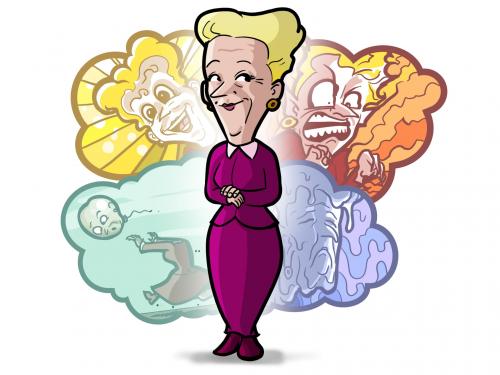
Because some famous artists, writers, and scientists have suffered from bipolar disorder (BPD), it has usually been associated with genius. This is of course more satisfying than if it were associated with stupidity but, in truth, it doesn’t help us at all…
There are different types of intelligence but what I find particularly relevant here is the following saying: intelligence is not having all the answers, it is having all the questions.
As a Bi-Polar Lander I have always found that the first step towards improving my understanding of the way my illness is affecting me is indeed to ask MYSELF questions, especially those that are known as ‘powerful questions’ - i.e.open questions starting with:
Here a a few examples of what I mean:
You get the idea.
These questions are powerful because they cannot be answered with a simple yes or no, and they force us to think which is important because we can so easily get trapped in destructive behaviour and/or thinking patterns.
I must stress that all this is all well and good when we feel well enough to function. When we can barely get out of bed or we are so agitated that we have lost all perspective then such an intelligent approach is just about impossible. As I have said previously, it is between episodes (depressive and manic) that we have the opportunity to ask these questions, or indeed when our medication has succeeded in getting us back to a relatively stable state.
It is also important to note that our attitude to our self-awareness and self-responsibility is crucial in this regard. Asking ourselves powerful questions requires us to be sufficiently self-aware and self-responsible.
Asking questions encourages us to develop and keep a curious mind, and such a mind is the very foundation of our learning ability. And learning is certainly something we need to do if we wish to survive Bi-Polar Land…
We need to learn about:
Having written this far, the above is obvious and hugely important. What is not usually appreciated is that learning for learning’s sake is also hugely important. Learning ANYTHING mental or physical is good for the brain and good for our morale - both brain and morale play a starring role when living with a mental illness!
Whatever it is you are interested in, study it. It doesn’t have to be like attending school or college because even learning something while wrapped up in your pyjamas in bed is good for you.
And it doesn’t have to take hours either - just being able to say “really? I didn’t know that” keeps your brain engaged with discovery and your mind open to possibilities..
Read, watch TV or videos, listen to the radio or podcasts, have a look at what is on the internet with a critical mind so that you can decide what is trash and what is worth paying attention to. In Bi-Polar Land doing all that with an interest in learning is very good.
And, physical learning is good too. Learn to dance, learn to knit or crochet, learn woodwork, learn to cook. Once again ANY learning is very good.
In fact I would go as far as saying that the worst thing that can happen to us Bi-Polar Landers is to close our mind to new learning - our world is often ‘shrunk’ by our illness so learning gives us the opportunity to stretch our mental reach beyond the limits imposed upon us by our BPD.
Learning is proof that we are still alive.

 Copyright © 2000-2024 Gabrielle Blackman-Sheppard, unless otherwise stated. Copyright ownership of all caricature illustrations belongs to Greg Blackman. All rights reserved.
Site built by Silicon Meadow & hosted by Origin Services